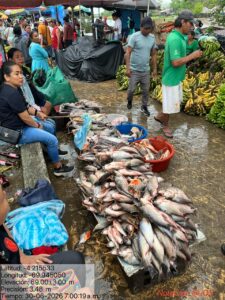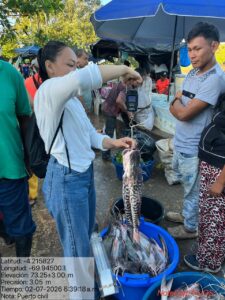

TIKÀ, an organization of Indigenous fishers representing seven communities in Leticia, in the Colombian Amazon, expanded its fisheries monitoring efforts to the Port of Leticia. There, its members draw on their knowledge of fish and fishing into practice to document what happens after a catch—from unloading and sale to storage, and transport.
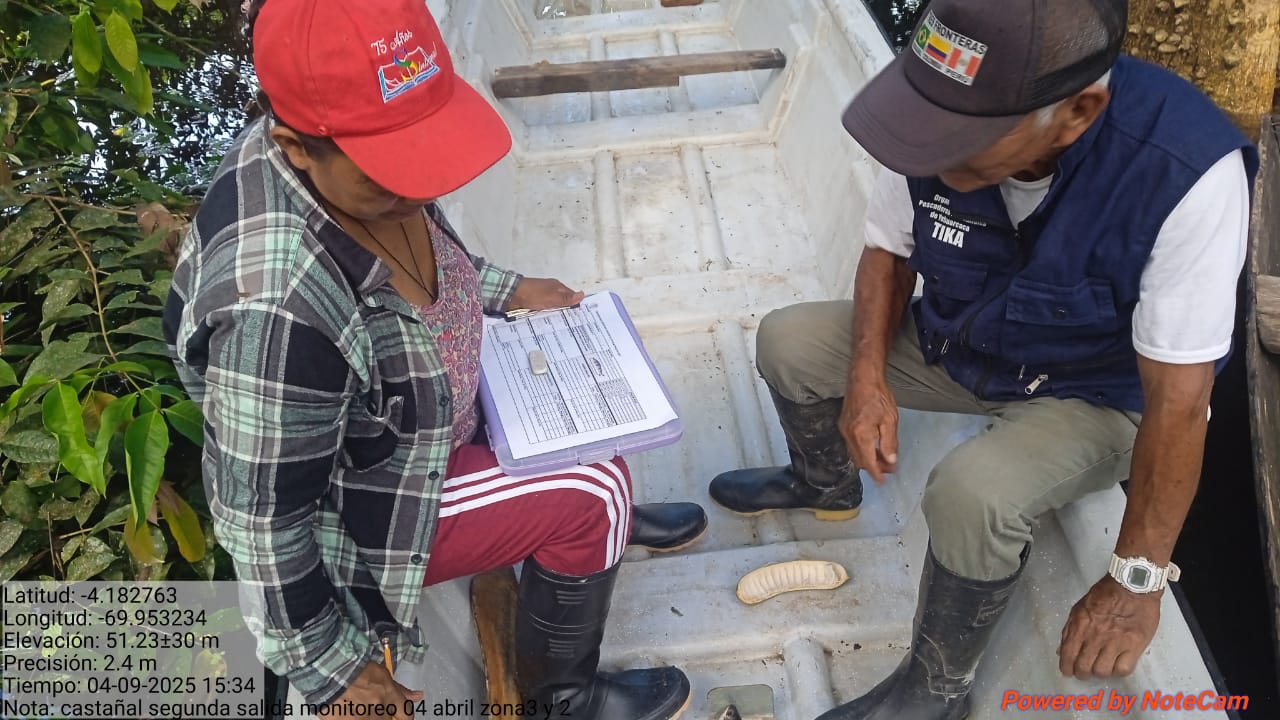
Monitoring visit by two TIKA representatives. Photo: © Grupo Proa
What happens to fish after they are caught? Monitoring at the Port of Leticia made it possible to track their movement through landing sites, storage facilities, and sales areas, while collecting information on their places of origin and destinations.
The initiative was carried out through a partnership among TIKÀ, Grupo Proa, and the Wildlife Conservation Society (WCS). TIKÀ members conducted the monitoring drawing on their knowledge of fish and fishing activities. Grupo Proa coordinated the implementation and supported the organization of the monitoring activities, training, and data tracking as part of its collaboration with WCS.
Between May and September 2026, TIKÀ’s monitoring team recorded 909 digital observations across 100 different dates. The records included information on the species being sold, their places of origin and destination, and the fishing gear used to catch them, as well as length and weight measurements when available.
TIKÀ: knowledge and work rooted in the territory
TIKÀ is the Artisanal Fishers’ Organization representing the seven communities connected to the Yahuarcaca lakes and stream system in Leticia. Its members are primarily Indigenous fishers from the Tikuna, Cocama, and Yagua populations.
Its area of activity covers approximately 1,300 hectares of lakes, streams, and flooded forests, encompassing more than 21 interconnected lakes and around 12 kilometers of stream. Approximately 1,200 families live around this system, across seven communities, Indigenous territories, and other rural settlements.
The Yahuarcaca lakes and stream system is essential to artisanal fishing, food security, and the livelihoods of local communities. Its aquatic environments and flooded forests also support biodiversity and contribute to Leticia’s water supply.
TIKÀ works on environmental governance, biocultural monitoring of fisheries and the territory, monitoring compliance with fishing agreements, environmental education, and the transmission of traditional knowledge. Its members’ knowledge of fish species, seasonal patterns, and fishing locations provides an important foundation for understanding fishing activities and changes across the territory.
New connections for understanding Amazonian fisheries
Monitoring at the Port of Leticia enabled TIKÀ to connect with other people involved in the fishing sector, including fishers, consumers, fish-collection rafts, and marketing establishments. These interactions created opportunities for collaboration and greater recognition of Indigenous fishers’ knowledge. TIKÀ’s brought its experience from the territory into dialogue with those involved in receiving, storing, and selling fish, gaining a broader understanding of the different stages a catch goes through.
The experience also provided insights into the cross-border nature of Amazonian fisheries. Fish arriving in Leticia are part of a regional network that links Peru, Colombia, and Brazil through fishing grounds and trade routes. Understanding these dynamics requires looking beyond individuals to consider the landing sites and markets connected across national borders.
The data collected help quantify these regional flows. Among the records that included information on country of origin, 58.5% corresponded to Peru, 24.3% to Brazil, and 17.1% to Colombia. The monitoring also identified destinations such as Bogotá and the local market, illustrating how the port connects Amazonian fisheries with food supplies and markets elsewhere in Colombia.
“Conducting this monitoring at the port was a challenge for us as TIKA monitors. We realized that fish arrive from Brazil and Peru, in different sizes. We also saw that, although there are still very large fish in the Amazon, others are becoming increasingly smaller,” says Georgina Rubio Vargas, a TIKA member and monitor and fishing coordinator from the community of La Milagrosa.
In this process, fishers’ knowledge of species, seasonal patterns, fishing locations, and river dynamics was complemented by digital data-collection tools and monitoring protocols. This combination can generate valuable information for communities, as well as support fisheries research and management.
Seven TIKÀ members took part in the monitoring from May to September 2026: five women and two men. The team included two young people, aged 18 and 20. The experience provided an opportunity for practical training and intergenerational knowledge exchange, helping strengthen the organization’s capacity.
By connecting the territory, the port, and markets, TIKÀ gains a broader understanding of Amazonian fisheries. The information gathered provides a basis for dialogue with other stakeholders, and can inform decisions on fisheries management, particularly regarding resources that are essential to communities’ food security and livelihoods.